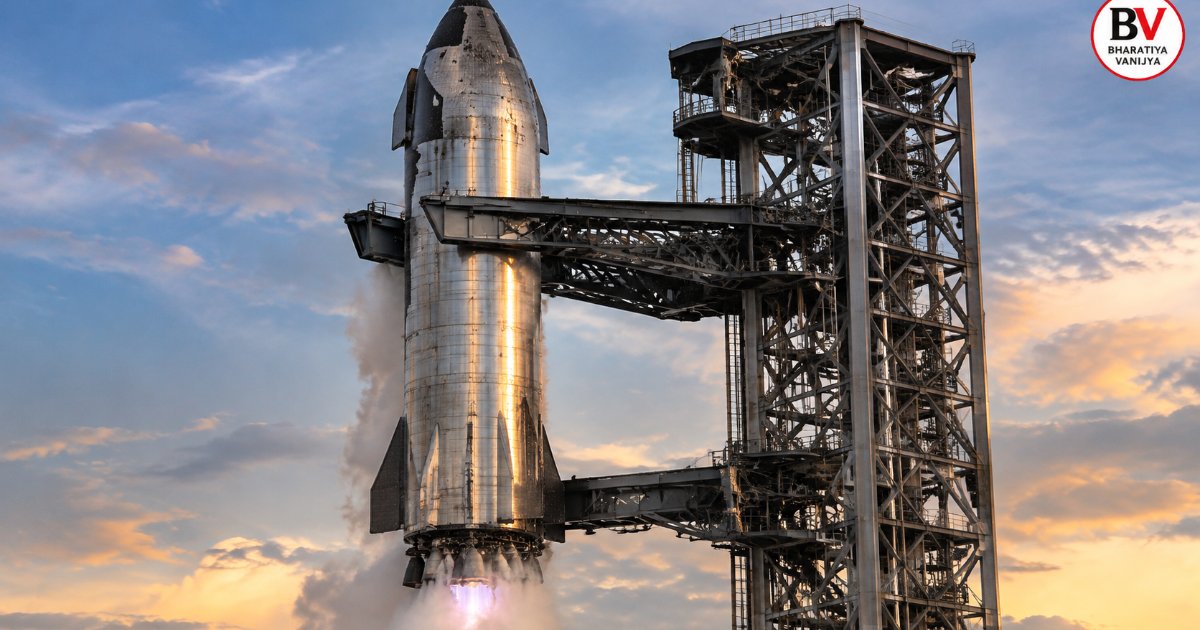
New Delhi, November 18, 2026: SpaceX has achieved a major milestone in reusable rocketry after its Starship upper stage returned from orbit and was successfully caught by the launch tower at Starbase, Texas. The achievement came during Starship’s 15th test flight and marked the first time an orbital Starship upper stage was recovered directly at the launch site.
Historic Tower Catch
The spacecraft, known as Ship 42, spent about 22.5 hours in space and completed 14 orbits around Earth before beginning its journey back to Starbase. During the return, it performed a controlled descent and aligned itself with the launch tower.
“Two enormous mechanical arms, known as “Chopsticks,” closed around the descending spacecraft and secured it above the launch pad. The maneuver demonstrated that…”
What Happened During Flight
Starship lifted off from SpaceX’s Starbase facility in South Texas on November 13. After separating from the Super Heavy booster, the upper stage continued its orbital mission and deployed 26 Starlink V3 satellites.
The spacecraft then completed its orbital operations before re-entry. Its successful return provided SpaceX with an intact vehicle for inspection.
Booster Recovery Failed
The mission was designed to demonstrate a “double catch”, with both the Super Heavy booster and the Starship upper stage returning to the launch tower. However, the booster did not complete its recovery attempt.
An automated system aborted the planned tower catch after the booster experienced a low-fuel condition during its return. It was diverted toward the Gulf of Mexico, where it splashed down and broke apart.
SpaceX chief Elon Musk later attributed the booster problem to engine performance and said improvements were underway.
Why It Matters
Recovering the upper stage is one of the biggest technical challenges in SpaceX’s plan to make Starship fully reusable. Unlike Falcon 9 boosters, which have demonstrated repeated landings, Starship must survive orbital flight, atmospheric re-entry and a precise return to the launch site.
Successful recovery could eventually reduce refurbishment time and launch costs while increasing flight frequency. The technology is also important for ambitions involving Starlink, lunar missions and Mars exploration.
A Major Step Forward
The Flight 15 mission was not a complete success because the booster was not recovered. However, the first successful tower catch of an orbital Starship upper stage represents an engineering achievement and moves SpaceX closer to its goal of rapidly reusable heavy-lift spaceflight.