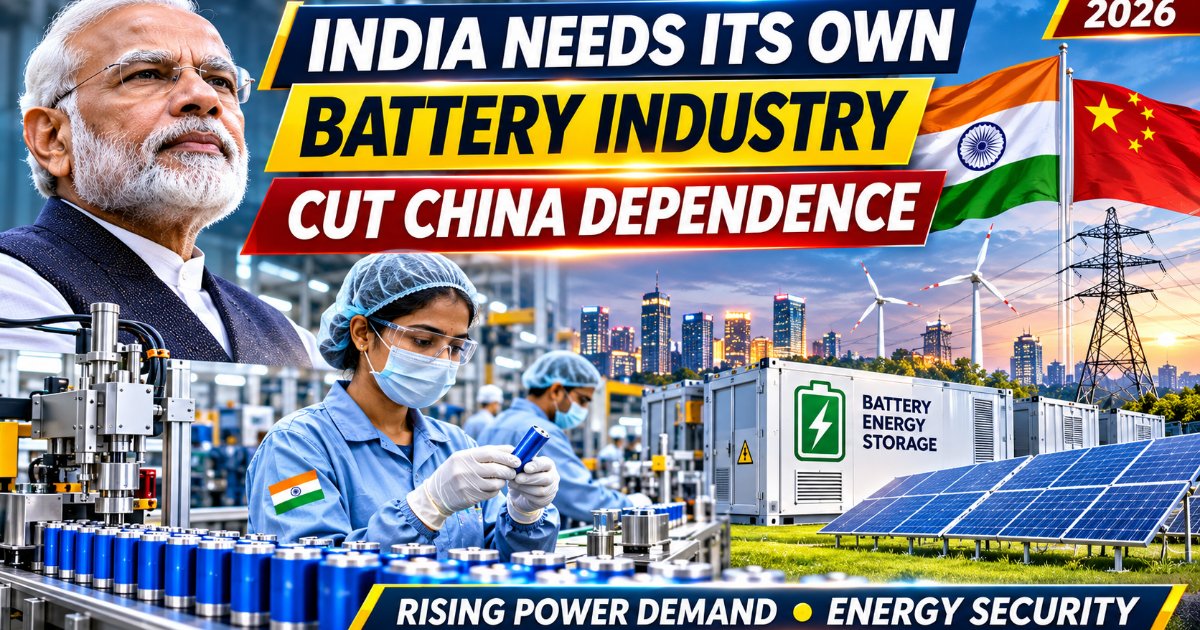
New Delhi, November 14, 2026: India's growing electricity demand and rapid expansion of solar and wind power are placing battery storage at the centre of the country's energy strategy. Experts warn that without a strong domestic battery industry, the transition to clean electricity could leave India heavily dependent on imported technology, particularly from China.
Why Electricity Demand Makes Storage Essential
Electricity consumption is rising as Indian cities expand, industries electrify and air-conditioning, digital infrastructure and electric vehicles become more common. Solar panels generate most electricity during daylight, while wind power varies with weather. Demand, however, often remains high after sunset.
“Battery energy storage systems (BESS) can absorb surplus electricity when supply is abundant and release it during evening peaks. They also help stabilise frequ…”
The Central Electricity Authority's National Electricity Plan projects a BESS requirement of 47.24 gigawatts, equivalent to 236 gigawatt-hours of storage, by 2031-32. Pumped hydropower will provide another major form of flexibility. These figures represent projected requirements rather than capacity already operating.
China's Dominance Creates a Supply Risk
India currently imports most advanced battery cells. Although some domestic companies assemble battery packs, manufacturing the individual cells and essential materials remains far more challenging.
China dominates global lithium-ion cell production and several crucial processing stages, including graphite anodes and cathode materials. The International Energy Agency estimates that Chinese facilities account for more than 80% of global battery-cell production.
This concentration exposes Indian developers to potential disruptions caused by export restrictions, shipping delays, price fluctuations and geopolitical tensions. Cheaper imports can help build storage projects quickly, but relying on a single dominant supply chain creates longer-term vulnerability.
Domestic Battery Manufacturing Is Growing, but Slowly
The government introduced an Rs 18,100-crore production-linked incentive programme to support 50 gigawatt-hours of advanced chemistry cell manufacturing capacity. By June 2026, 40 GWh had been awarded to four beneficiary firms, but only 1.4 GWh had been commissioned under the scheme, according to an official parliamentary reply. The distinction between announcing a gigafactory, assembling battery packs and producing commercial-quality cells matters. Successful local manufacturing demands specialised equipment, consistent materials, skilled workers, rigorous testing and sustained demand. In a fresh development on November 12, the Ministry of Heavy Industries announced that 22 bidders had responded to a tender for the remaining 10 GWh of cell-manufacturing capacity, earmarked for grid-scale stationary storage. The bids demonstrate interest, but they do not mean new factories are already operational.
Government Approves New Energy Storage Support
On November 4, the Union Cabinet approved Rs 14,500 crore in viability-gap funding to support 92 GWh of new grid-scale storage capacity. The planned mix includes 30 GWh of batteries, 60 GWh of pumped storage and 2 GWh of emerging technologies. The scheme also introduces a minimum 40% domestic-content requirement for battery-storage projects receiving support. This could encourage Indian manufacturing, although suppliers will still need affordable components and reliable technology.
India Needs More Than Battery Assembly Lines
A resilient battery industry requires investment across the entire supply chain, from cell components and mineral refining to testing, software, safety systems and recycling. India's National Critical Mineral Mission seeks to strengthen mineral exploration, processing and recovery. Partnerships with multiple resource-rich countries can diversify supplies of lithium and other materials. Recycling used electric-vehicle and stationary batteries can eventually recover valuable metals, although sufficient volumes of retired batteries will take time to emerge. Indian companies must also invest in research into lithium iron phosphate, sodium-ion and other suitable chemistries, while maintaining stringent fire-safety standards. Financing, dependable procurement contracts and access to skilled technicians will be equally important.
A Strategic Choice for India's Energy Future
India needs batteries that are reliable, competitively priced and available at scale. Building every component locally overnight is unrealistic, and carefully managed imports will remain important during the transition. The practical goal is to expand domestic cell production while diversifying raw-material sources, developing recycling and making manufacturing commercially viable. If that effort succeeds, growing electricity demand could become an opportunity for jobs, industrial growth and energy security rather than a new form of import dependence.