For years, China has been a dominant force in the global caffeine market, supplying manufacturers of energy drinks, soft drinks, pharmaceuticals, dietary supplements and other products. But changes in Chinese export incentives and shifting trade dynamics are creating an opportunity for India to strengthen its position. One Indian company is already moving to capitalise on this shift: Aarti Pharmalabs, a manufacturer of caffeine and other xanthine derivatives that is expanding capacity as global buyers reassess their supply chains. The important distinction is that this is not simply a story about China stopping caffeine exports altogether. It is about Chinese products becoming less advantaged by export policy, the economics of competing supply sources changing, and Indian manufacturers potentially gaining business as international buyers diversify.
1. What is changing in China’s caffeine supply chain?
The key development is the withdrawal of China's 13% export rebate benefit on caffeine and its salts, as discussed by Aarti Pharmalabs' management in its February 2026 earnings call. According to the company, the change could improve international pricing by reducing the cost advantage previously enjoyed by Chinese exporters. Management estimated that prices could eventually rise by approximately 8–10%, although this was a forecast rather than a guaranteed outcome. Why does this matter? - Pricing advantage could narrow. Chinese producers may no longer benefit from the same export incentive, potentially improving the competitive position of manufacturers elsewhere. - Global buyers have reasons to diversify. Companies increasingly consider alternative suppliers to reduce their dependence on any single country. - Trade policy adds another variable. Tariffs and market-access rules can change the relative cost of sourcing from China, India and other manufacturing hubs. However, the evidence does not establish that China's caffeine supply has been completely cut off. The more accurate interpretation is that its export economics are changing, creating a potential opening for competitors.
2. The Indian company already preparing to capitalise
Aarti Pharmalabs Limited Headquartered in India · Pharmaceutical ingredients and xanthine derivatives Aarti Pharmalabs is one of India's leading caffeine manufacturers. Its investor disclosures describe it as a non-Chinese-dependent, integrated producer of xanthine derivatives, a chemical family that includes caffeine and related compounds used in beverages and pharmaceuticals.
What makes Aarti particularly relevant is that it was building capacity before the latest pricing shift became a potential advantage. Previous disclosed capacity 5,000 metric tonnes per year Expanded installed capacity 9,600+ metric tonnes per year
The expanded capacity represents an increase of more than 90% over the previously disclosed 5,000-tonne level. Aarti's August 2026 investor presentation reports the expansion and describes a phased production ramp-up through the end of FY2027. The company's February 2026 earnings-call discussion also indicated that management expected the removal of China's export rebate to support pricing. In the same discussion, it highlighted the potential benefit of the relative US tariff treatment of Indian and Chinese caffeine. These are company management's assessments, not a guarantee of future profitability or export growth.
3. Why caffeine matters to so many industries?
Caffeine is not just an ingredient in coffee. Industrial-grade caffeine is used across several important sectors: - Beverages: cola drinks, energy drinks and other caffeinated beverages. - Pharmaceuticals: formulations where caffeine is used as an active ingredient or in combination products. - Nutraceuticals: sports nutrition, pre-workout products and certain dietary supplements. This diversity creates a broad customer base, but it also means suppliers must meet different specifications, documentation requirements and quality standards depending on the end use. A manufacturer cannot automatically redirect every tonne of production to every market. Aarti's FY2025 annual report identifies beverages, nutraceuticals and pharmaceutical applications among the end markets for its xanthine derivatives. Its disclosures also show that the segment is a meaningful part of the company's business.
4. The opportunity is real, but India still has ground to cover
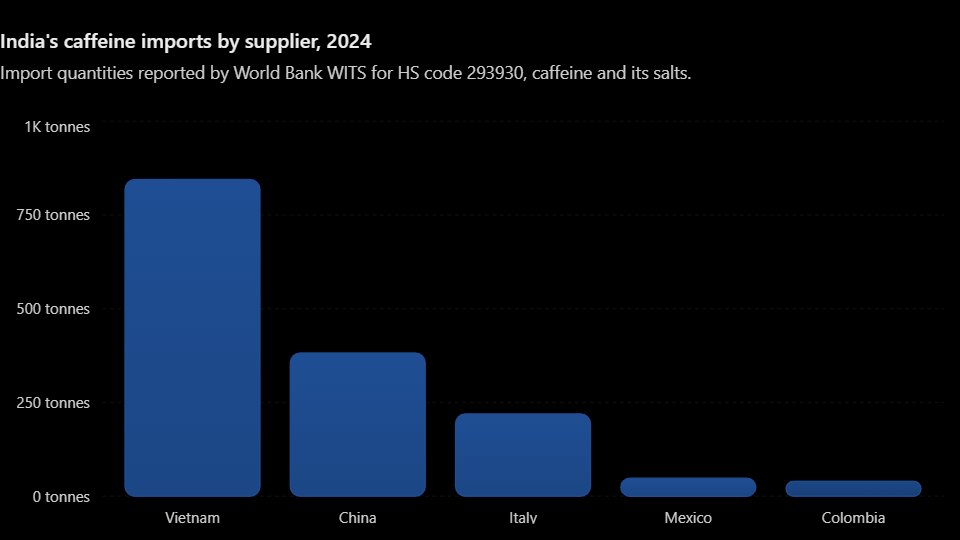
Trade data shows why this is an opportunity rather than a completed takeover. According to World Bank WITS data based on UN Comtrade, India's 2024 imports of caffeine and its salts were worth approximately US$21.74 million, representing about 1,561 tonnes. China supplied approximately 382 tonnes, worth US$3.57 million, while Vietnam was the largest listed supplier, providing around 845 tonnes. India's caffeine imports by supplier, 2024 Import quantities reported by World Bank WITS for HS code 293930, caffeine and its salts. These figures establish three important points: 1. India already has a substantial caffeine manufacturing and trading ecosystem. 2. Chinese supply is significant, but it is not India's only source of imports. 3. Any shift in global sourcing will play out across multiple countries, with Vietnam particularly important in India's own import market. There is an important limitation to this comparison: India's import figures measure caffeine entering India, not the volume of Chinese caffeine sold worldwide. They therefore cannot, on their own, establish how much of China's global market India could capture.
5. What could India gain from the shift?
If the policy changes translate into sustained price improvements and customers qualify additional Indian suppliers, India could benefit in several ways. Higher export opportunities. Overseas beverage and pharmaceutical manufacturers may consider Indian suppliers for new contracts, particularly where supply diversification is a priority. Better pricing conditions. If the Chinese export incentive disappears without a comparable reduction in production costs, competing suppliers could face less price pressure. The actual outcome will depend on market demand, production costs, inventories and competitor responses. Greater investment in manufacturing. A larger addressable export market could support further capacity investment, process improvements and quality-control infrastructure. A stronger position in the China+1 strategy. International buyers seeking alternatives to Chinese sourcing may view established Indian manufacturers as potential long-term partners rather than emergency replacements. Aarti's capacity expansion is a tangible example of this positioning. Its August 2026 investor presentation reports expanded xanthine-derivative capacity of more than 9,600 tonnes annually and a target to increase its global market share from 15–20% to 20–25%. These figures are company-reported estimates and targets, not independently verified market outcomes.
6. What could prevent India from taking the lead?
The opportunity should not be confused with guaranteed market dominance. Several factors will determine whether Indian producers can turn a policy change into lasting commercial gains. - Chinese manufacturers may remain highly competitive. They could absorb part of the cost change, improve efficiency or adjust export prices. - Capacity is not the same as output. A factory's installed capacity does not mean every tonne is being produced, sold or exported. - Regulatory approvals matter. Pharmaceutical-grade customers may require extensive documentation, audits and market-specific approvals before switching suppliers. - Other countries are competing too. Vietnam, Germany and other established suppliers may also benefit from changing sourcing patterns. - Demand and pricing can move in opposite directions. Even if prices rise, slower demand or higher input costs could limit manufacturers' profits. Aarti's management has discussed the possibility of improved pricing and export competitiveness, but the scale of any benefit will depend on actual orders, utilisation, product mix and realised selling prices.
7. The bigger picture: a supply-chain opportunity for India
The caffeine market illustrates a broader shift in global manufacturing. Changes in trade policy can create openings for countries that already have the manufacturing infrastructure, technical expertise and customer relationships needed to respond. India is not entering the caffeine business from scratch. Companies such as Aarti Pharmalabs have established production capabilities and are investing in additional capacity. If China's export advantage weakens and international buyers continue diversifying their suppliers, Indian manufacturers could capture a larger share of the market. But the decisive factor will not be the policy announcement alone. It will be India's ability to deliver consistent quality, competitive pricing, reliable volumes and the regulatory standards required by global customers. The bottom line: China's caffeine export-rebate withdrawal could create a meaningful opportunity for India, and Aarti Pharmalabs is already positioned to pursue it. The shift is best understood as a potential redistribution of global market share—not a complete cutoff of Chinese caffeine or an assured Indian takeover.